Tuesday, November 22, 2011

Overcoming All Odds: Lauren Myracle


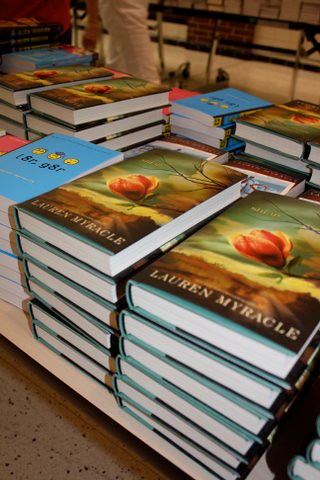
The dust has begun to settle on the National Book Awards scandal. Lauren Myracle was in the running, then pulled, and once Thanhha Lai won in the Young People's Literature category on Wednesday, few people have mentioned Myracle. But her novel, Shine, basked in the National Book Awards news coverage (a.k.a. free publicity), and as an author, Myracle is selling books more than ever before.

Throughout high school, college, and even post-graduation, Myracle met people who insisted she should forget writing. A professor once told her not to bother joining an advanced English course because she wasn't good enough. But Myracle wouldn't take it. "I decided that teacher could tell me I couldn't take her class," Myracle told a Chicago audience at Anderson's Bookshop on Sunday. "But she couldn't tell me not to become a writer."

After graduate school, the Examiner wrote, the author was rejected 118 times before she found an editor who would pay attention to her work. "I wrote [that first novel] five times in a two-year period," Myracle said. Finally, she got a piece of good news: Abrams Books for Young Readers publisher, Susan Van Metre, offered the Shine author a contract. The novel, Kissing Kate, hit bookstores in 2003.

In the last nine years, Myracle has published over twenty works, including ttyl, the first novel ever to be written entirely in instant messages. In 2009, the American Library Association said that the author's books were the most challenged of the year due to their real and often intense scenes of alcohol abuse, sexual encounters, and homosexuality. Even without the added scandal associated with the National Book Awards, Myracle's latest novel, Shine, continues to ruffle feathers in it's own way. Librarians and parents have already protested the book's story line - a teenage girl who tries to discover the who/where/when/why of her gay best friend's murder.

Forget controversy. Forget discouragement. Myracle's two- cents? "Other people tell you you're foolish to want to do [something], but don't give up." With the number of factors working against her, Myracle writes what she wants no matter who says it won't sell, and still manages to give many YA authors a run for their money.

"I live in my own little world," the author says. "But its ok, they know me here."

Monday, November 21, 2011

Occupational Hazards: Debt, Jobs, and Broomsticks


Something a little different today. Here is a short piece about one of my first jobs in the city:


I really needed a job. I was willing to take pretty much anything.

Chicago winter had hit me hard. I had an old car, a drafty apartment, and an empty bank account. The snow had begun the weekend I moved and hadn’t stopped. From a friend of a friend, I had picked up some temp part-time work for minimum wage, but I needed something else soon or I wasn’t going to make it through my first season in the city.

After my shift one night, a co-worker from a different department approached me to say she had an opening for a bizarre position at her other company. It wasn’t much: child wrangler meets house manager for student performances of "The Wizard of Oz."

The job was simple. Wait next to the theater door for a school bus. Then hop on, make some announcements, and wrestle the kids into a line. Also, the El train will be rolling overhead, making it impossible to shout instructions and causing many of the kids to scream. And it will likely be snowing or raining. Pay is $30 a day, before taxes.

“I’ll take it.”

My first day of work, two buses pulled up late, another got lost, one school brought a student with accessible needs and the elevator stopped working, and a first grader threw up in the lobby. I walked six blocks in the rain to bring the show materials back to the main office and then scrambled back into the storm to bum a train ride home. On the way, someone shouted to “move out of the way because I was so ugly I was stopping traffic.” Needless to say, I couldn’t believe I took this crazy job. I was cold, struggling with debt, and working ridiculous hours helping middle-schoolers learn what “single file line” means. To be honest, I was terrified. What if something happened to one of the kids on my watch? What if I caused a traffic accident with the buses? What if I was simply horrible at this position? For now, though, I didn’t have any other options.

Fast forward to Week #5. Back-to-back shows in the morning. In the span of twenty-five minutes, we needed to get 350 elementary school kids out of the theater, onto the correct buses, clear the street, coordinate the next round of schools, and usher 350 different children to their seats inside. With the help of the office staff, we made it just before the second show was slated to begin. Miracle of miracles. I knelt down to take a breather in the lobby.

The doors inside the theater opened and a preschooler walked out, crying. His chaperone couldn’t calm him down. The two of them circled the space and finally sat on the chairs in the corner. I walked over to say hello.

“He’s scared of the Wicked Witch,” the chaperone explained while the boy stared straight ahead, sniffling and avoiding eye contact.

I sat down next to him and said that I was scared of spiders.

He looked up and blinked. “Big spiders?” he asked, and wiped his runny nose on the sleeve of his jacket.

“All spiders. Big. Little. Slimy. Hairy. I’m scared of all kinds of spiders.”

The three of us sat in silence for a moment.

“Want to know a secret?” I whispered. The boy nodded, not quite sure if he trusted me. “Sometimes, I talk to spiders, too. Just to say hi. They never talk back, but I imagine what they would say anyway. Sometimes I think they might ask about what music I am listening to or what movie I like to watch on the weekends. I talk to lots of spiders. It makes them seem less scary. Does that make me weird?” He nodded.

From the side entrance, the actor playing the Wicked Witch came out and waited for his cue. In the florescent glow of the lobby lights, his green make-up looked pale instead of sickly, and he scratched his nose with the tip of his pointy hat. I grinned and motioned for him to come over.

The actor sat down on the carpet and inspected his broom. The boy’s lip quivered, but he didn’t move from his chair. The Wicked Witch continued to play with the bristles and the boy looked on. Inside the house, the piano tune to “We’re Off To See The Wizard” bled through the double doors. After a moment, the boy reached out to touch the broom, too. Both boys, the actor and the preschooler, rubbed the rough, itchy broom hairs in a rhythmic, almost therapeutic motion.

“Your nose looks like mine.” The boy felt the witch's black cape in the same rhythmic way with his fingertips.

The Wicked Witch stood up. “I’ll wave to you from the stage, OK?” The boy nodded and the actor ducked in to make his entrance. Without another question, the boy stood up and walked back inside, ready for whatever the play had in store.

That week, I got a phone call from the temp agency – they had found me a full-time job at a law firm answering phones. Business attire. Thirty minutes for lunch. Could I start Monday?

I looked outside at the snow and sleet and rambling El train, and respectfully declined the offer. The job at the theater was hardly a paycheck, but I liked the challenge. My duties were always different and sometimes daunting, and that was exactly what I wanted. There was no use being afraid of chaos when I loved the excitement. Soon enough, I’m sure I could fight my way out of debt. In the meantime, I had kids and broomsticks to wrangle.
Sunday, November 20, 2011

Jumping the YA Bandwagon


Since the recent explosion of many hits in the young adult fiction world, several publishers with mainly adult or children's reading material have stepped into the YA genre. Chicago-based publishing house Albert Whitman and Company (most famous for the Boxcar Children series) has been printing children's lit since 1919. This was the first year the company launched a young adult line, "Albert Whitman Teen," which included only two titles: Michael Ford's The Poisoned House and Anna Perera's Guantanamo Boy. Coming Spring 2012 will be Anna Perera's The Glass Collector and Deborah Blumenthal's The Lifeguard. The company says their list of YA titles are "smart, fearless books that explore unchartered territory in the world around teens and in their inner lives as well."

Angry Robot Books, on the other hand, has been printing adult science fiction and fantasy books since 2009. They just announced that, come September 2012, the company will also launch a YA line called "Strange Chemistry," with the hopes to print one YA book a month from there on out.

Many publishing houses are embracing the young adult genre, and it looks like other companies will soon follow!

Friday, November 18, 2011

So It's Like "The Office"...But With Books?


For some teens, the initials BFF stand for "best friends forever." For many others recently, BFF stands for "Backlit Fiction Forward," a new and innovative publishing company for the young adult audience.

"Backlit is a next-generation digital media publishing company that creates eBooks and interactive apps based on original franchises," says the company's Facebook page. It "incubates teen serials as episodic apps and film and television properties." In other words, Backlit makes the equivalent of sitcom eBooks, and release each episode as it is written. Teens then have the opportunity to stay connected more often - they can follow an eBook series the same way they can a television series. "We are reinventing publishing by shortening the path from writer to reader," says Jack Giarraputo, film producer of "Heavyweights," "The Waterboy," and "I Now Pronounce You Chuck And Larry" (among many others), and Backlit's creative adviser and lead investor.

The company's first series were recently released: Borrowing Abby Grace; The Start-Up; and The Dig: Zoe and Zeus.

Backlit recognized the habits of today's young adult audience, and saw the untapped opportunity in turning one more thing into a constant supply-and-demand. "Focused on Millennial readers with episodic attention spans," says Market Watch, "Backlit ebook downloads will be released exclusively digitally every few weeks, yet offer significant narrative depth."

The company has even thought further, past the books themselves as a product. They have become not only a self-marketing tool, but also encouraged a kind of "audience participation" to keep readers hooked. Teens will have the upcoming opportunity to win "character walk-on" roles in ebooks, and the Mentors Program will launch in the next weeks, "whereby the publisher will mentor and crowdsource new YA authors to write new episodes."

Backlit has tapped into the growing trends of ebooks and young adults, and supplied a unique experience for teen readers. Upcoming series include Young Americans, Future Perfect, and The Defiants, to be released early next year.

Thursday, November 17, 2011

A Bittersweet Victory


The 2011 National Book Award Winners were announced last night. Audiences applauded the well-deserved wins:

Fiction: Jesmyn Ward's Salvage the Bones
Non-fiction: Stephan Grenblatt's The Swerve: How the World Became Modern
Poetry: Nikky Finney's Head Off & Split
Young People's Literature: Thanhha Lai's Inside Out & Back Again

Five finalists had been chosen for each category. Each finalist won $1,000 and a medal, and each winner received $10,000.

I still wonder, though. After everything that happened in the young adult category with Lauren Myracle's Shine, did Franny Billingsley even have a chance with Chime? (Get caught up with the backstory here). Had too much dust already been kicked up with the two novels? Did the controversy skew the judges final decisions? While National Book Award higher-ups insist that the mix-up "will never happen again," did Chime getting thrown into an unavoidable debate ruining Billingsley's chances?

Regardless, Lai's award-winning YA novel is worthy of the honor and praise it has received. And hopefully the next time Billingsley and Myracle find themselves on the finalist lists for major awards, they will get a fair judging.

Wednesday, November 16, 2011

Chapter One: "Call me Ishmael."


Books are either memorable or they're not. You either finish reading them or you can't. You either recommend stories or you don't. But the first line certainly makes a difference.

"124 was spiteful" - opening line to Tony Morrison's Beloved.

"All this happened, more or less" - beginning of Kurt Vonnegut's Slaughterhouse-Five.

And how could you refuse: "I was born twice: first, as a baby girl, on a remarkably smogless Detroit day in January of 1960; and then again, as a teenage boy, in an emergency room near Petoskey, Michigan, in August of 1974." (Jeffrey Eugenides' Middlesex)

First lines prepare you for the story that almost never unfolds the way you thought it would. You meet the narrator who may or may not be reliable. You read that first line and decide, "Am I committed to this book?"

InfoPlease has compiled a list of the 100 best first lines, ranging from 18th century English prose to 1980s gritty text.

Leave a comment with your favorite first book lines!

Tuesday, November 15, 2011

Read and Write in the World's Top Ten Literary Cities


In their September 2011 issue, National Geographic posted an article about the top 10 literary cities in the world. You can read about recommended travel sites for writers, and about novels that were penned in and about those cities.

In Stockholm, Sweden (#6 on the list), travelers can visit the many places described in Stieg Larsson's popular book, The Girl With the Dragon Tattoo, as well as the statue dedicated to Pippi Longstocking author, Astrid Lindgren. On the way out, you can stop by City Hall to check out the location for the annual Nobel Prize dinners.

Number 9 is Melbourne, Australia. There you will find the 200-year-old State Library of Victoria, and exhibits in three galleries. In the back, visit the La Trobe Reading Room, a massive octagon-shaped space covered in engraved quotes by famous authors and classic thinkers. The weekly Saturday book market can be found in Fed Square, close to a bar called the Drunken Poet, where portraits of well-known authors hang on the walls.

If nothing else, stay the night at the Heathman Hotel in Portland, Oregon (#7) to get the "Books by Your Bedside" package. This includes a "personal tour of the lodging place's 2,000-volume library, made up entirely of signed books by author guests."

Read the full list of cities and sites here.

Monday, November 14, 2011

Book Review: Kate Cann's "Consumed"

In many current young adult books, settings include either modern-day reality or fantasy life. Rarely do they include both. Kate Cann's 2011 Consumed tells the story of teenager, Rayne, and her new home at a place called Morton's Keep. When I first began reading, I assumed I was starting a book about witches and spells and evil spirits. Well, I was, but the reader learns halfway into the book that just outside of the main action is regular old London, full of coffee shops and gossip and television. Plenty of normal day-to-day events are happening all over the world.

But in Morton's Keep, ancient pagan spirits are about to be released, after being contained for hundreds of years. No one is sure what or whom is behind it, but one thing is clear. Rayne has some sort of connection with the only one who can stop it: a pagan goddess everyone calls "the green lady." Non-stop action and infinite questions consume the reader until the last word.

Structure: 4 out of 5 stars

From page 1, I was intrigued. When the story begins, Rayne has been caught up in some violent love triangle, which concludes in a dungeon fire. This, however, is only the tip of the iceberg for both violence and love triangles, as well as a mess of confusion, betrayal, and unlikely friendships. Cann keeps her chapters short. There is never a lull in the story line, and the reader continues to get caught up in the ancient myths.

Though I discovered after I finished the book that Consumed is a sequel to Possessed (and I assume much of the exposition is contained there), I would have liked to see a bit more back story for the new reader here. Many characters were introduced and events referenced right off the bat, and I found myself rereading some pages in the intro chapters to stay afloat. The story itself trapped me in a nice way, but it would have been a smoother read with a couple of extra detailed paragraphs bringing the new reader up-to-date. Overall, though, a great story.

Characters: 4.5 out of 5 stars

Rayne and her partner-in-crime, Ethan, lead most of the book, but a group of other characters round out the novel for a fulfilling read. The housekeeper, Mrs. Driver, seems like a background figure, but then takes hold of the last third of the book. The new house manager, Miss Skelton, continues to surprise and aggravate everyone in Morton's Keep until she takes a brutal shift halfway through the story. St. John Arlington, Possessed's antagonist, is an easy write-off as seemingly harmless, having been put to shame at the end of Book One, but then also reappears. And, of course, Ethan's crew of fire festival boys become necessary to the story and to everyone's survival.

Cann gives the reader an incredible group of characters. No one is ever certain who the enemy is, which keeps the cast of misfits on their toes. In a surprising act of agency, the author also leaves the fate of Morton's Keep in the hands of the teenagers; the adults in the story all step back and let the young adults lead.

In the last chapters, Cann references Miss Skelton's eerie past, as well as her niece, Tara's. If the author churns out one more read to make it a trilogy, I would be eager to hear more about some of the darker figures' pasts, and hear the "how" and "why" of their place in Book Two.

Voice: 4.5 out of 5 stars

Rayne dominates as the protagonist. She is confident without being cocky, she is cautious without being a wimp. Ethan relies heavily on her to keep the action moving. While a romantic tone follows the story line like a shadow, Rayne rarely lets any kind of stereotypical teenage girl (the kind often projected by the media) show. She is all business, albeit she doesn't mind the handsome company. While the reader trusts her, we don't quite know what is going on inside her head, particularly when she is consumed by sensations of evil.

That was one of the high points of Rayne's tale, honestly. She could walk into a room and feel something wrong, or approach a person and sense their dark thoughts - she is even drawn to different places in the woods or around the Morton's Keep grounds where help is needed, though she can't explain how. I love the way the reader and Rayne find those answers together. Again, I felt a little unknowing about Rayne for the first past of the book (where is her family, how did she get here, why is she alone - all things that were certainly explained in Possessed), but otherwise enjoyed her as the protagonist.

Cann has given readers a great story that isn't overwrought with romance, spells, or a dominating future government, though pieces of those themes do arise. Consumed is unique its place among other YA novels because it neither rejects nor fully embraces reality or fantasy. I recommend this book to readers interested in dark drama, adventure, paganism, and cultural myth.

Consumed was published in February 2011 by Scholastic.

Sunday, November 13, 2011

Really Good Authors! Really Bad Titles


People tell you not to judge a book by its cover. Or, for that matter, to reject a book for its title. For many authors, though, creating a captivating title for a new novel is often one of the hardest steps in the writing process. And they are among good company.

The website Flavorwire is one of many to have recently published articles about some of the best worst first titles for famous novels of the past. For example, publishers weren't sure anyone would touch a book called Trimalchio in West Egg, but Among Ash-Heaps and Millionaires didn't really work either. So they bounced around One the Road to West Egg. Then someone suggested Under the Red, White, and Blue, and, somewhere towards the end, The High-Bouncing Lover. Before it went to press, F. Scott Fitzgerald finally agreed that The Great Gatsby was the proper name for his new novel.

In the early 1800s, Jane Austen was pretty set on calling her second book First Impressions, but her publisher insisted Pride and Prejudice was more fitting.

William Golding first submitted his novel, Strangers from Within, to Faber and Faber for consideration. An editor suggested Lord of the Flies sounded more enticing.

Not all titles change because they lack aesthetic flare, however. Sometimes authors switch titles to remain unique. The phrase "catch-22?" The one we all use because of Joseph Heller's book of the same name? It was originally Catch-11, but Heller didn't want anyone confusing his novel with the recent release of the original Ocean's Eleven film. Then Heller tried for Catch-18. But Leon Uris' Mila 18 had also just been released. So Catch-22 it was.

Suddenly all the silly names you thought of for your first piece don't seem so strange, do they?

Read the full list of crazy titles here.

Saturday, November 12, 2011

Sendak, Seuss, and Silverstein: Back in the Game


Who says childhood can't go on forever? New books by beloved authors Maurice Sendak, Dr. Seuss, and Shel Silverstein have recently been published. Of the three, only Sendak is around to see his newest book hit stores. But all three new reads have excited fans and been well received.

As with many authors in the past and present, Sendak, Seuss, and Silverstein have seen their fair share of support and disapproval, during their lives and posthumously. Sendak, for instance, met strong criticism with his 1963 classic Where The Wild Things Are. Adults roared that the picture book was too scary for youngsters, even after it won the annual Caldecott Medal in 1964. "It is always the adults we have to contend with," said Harper & Row editor, Ursula Nordstrom. "Most children under the age of 10 will react creatively to the best work of a truly creative person."

Sendak, now 83, just published Bumble-Ardy, about a nine-year-old pig who has never had a birthday party. The opening illustration shows the enthusiastic main character proudly showcasing a newspaper with the top headline: "We Read Banned Books!" Time Magazine calls Bumble-Ardy "yet another mildly subversive children's book by a writer known for pushing - if not the absolute limits, at least poking around their edges." This is Sendak's first written and illustrated book in almost 30 years.

As for Seuss and Silverstein, readers are happy to see the collection of old and dusty words back out in the world. Seuss' new The Bippolo Seed and Other Lost Stories includes seven short stories that were first featured in magazines in 1950 and 1951, and are newly illustrated. Fans can read "Steak for Supper" and "The Strange Shirt Spot," among others.

Silverstein's Every Thing On It features 145 previously unpublished poems. The collection closes with a bittersweet couplet called "When I Am Gone," which resonates differently now that the well-known author has passed:

"When I am gone what will you do?
Who will write and draw for you?
Someone smarter - someone new?
Someone better --maybe YOU"

All three authors have contributed in major ways to the scope of children's picture books. They have inspired readers and writers, and will continue to do so as their books live on. As Seuss wrote in I can Read With My Eyes Shut!, "The more that you read, the more things you will know. The more that you learn, the more places you'll go."