Wednesday, November 9, 2011

E-Book Covers of the Future!


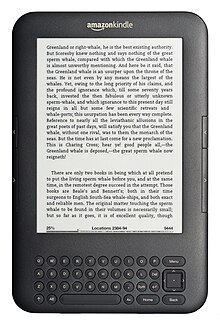
Electronic books are still a new-ish commodity, and already there are innovations on the horizon. UK children and YA publishing house Walker Books just announced their new plan for upcoming e-books: interactive book covers.

For its February publication of Daylight Saving by Edward Hogan, Walker Books will provide an e-book cover of the novel which responds to the reader's touch. Literary agent, Jonny Geller, tweeted in response: are interactive covers "better than a book trailer?"

Regardless, here is a bit about Hogan's debut novel (which of course fits perfectly with the clock switch from over the weekend), as per the online blog GalleryCat:

"Today, in fact right this second, the clocks are going back an hour. For most of us, this is a fantastic day as it means we get an extra hour to stay wrapped under the duvet, safe in our beds. But for one of the mean characters in Edward Hogan's debut young adult novel, Daylight Saving, this time of year brings nothing but fear...it's a thriller ghost story by a new voice in YA fiction that will have you utterly gripped. We can also tell you that this very night, when the clocks go back, is one that fills the characters with dread."

To win a chance to own an early copy of the book, leave a comment about your reaction to the innovative cover on the Under Cover Reads blog.

Tuesday, November 8, 2011

Online Publishing for Up and Coming Authors


In the new wave of e-books and self-publishing, authors are encouraged to not only hone their written word, but also begin to develop their publicity and marketing skills. Online publishing. Self-publishing. The new phenomenon doesn't seem like a trend - it's likely that it's here to stay. "A professional writer is a very small business of one person," said children's author Hazel Edwards (There's a Hippopotamus on Our Roof Eating Cake). "A solo trader in literary ideas. Those who are not buinsesslike are unlikely to survive."

Edwards, like many new children, YA, and adult authors, has skipped print publication altogether for the last few years and instead taken advantage of the new opportunities available online. By self-publishing, Edwards is responsible for maintaining her product and marketing it all on her own. But instead of the traditional 10 percent royalties an author receives through a publisher, Edwards earns closer to 35 percent of all royalties and sales.

"Authors can't earn a full-time wage from publishers' advances and royalties or fees from public speaking or freelance writing engagements," the Sydney Morning Herald recently stated. It is frustrating for non-celebrity authors who aren't household names, and often hard to make much of a profit. Self-publishing just might be the way to go. Take online publishing guru, Amanda Hocking.

After searching in vain for a publisher to take her fantasy YA novels, Hocking decided in March 2010 to just publish the books online as e-books. By May, sales were skyrocketing. B January of this year, she sold more than 450,000 copies of her books. While online publishing wasn't the only way to get her books into readers' hands, it definitely did the trick

"I can't really say that I would have been more successful if I'd gone with a traditional publisher," Hocking told USA Today in a recent interview. "But I know this is really working well for me." The online route isn't necessarily the only way to go forever, however. Even after all the success of the last year and a half, Hocking still recently signed with a print publisher because "her readers couldn't find her on bookstore shelves."

So publishing is a mixed bag right now. Some authors will continue to pursue Scholastic, HarperCollins, and Simon & Schuster, while others will try their own hand at Amazon publishing in the recent future. One thing is certain: writers certainly have more options and agency than ever before - they just need to taken advantage of the opportunities available.

Sunday, November 6, 2011

Book Review: Jessica Lee Anderson's "Border Crossing"


Isaiah Luis "Manz" Martinez is not the typical narrator of a YA book. He is not dealing with problems at school, parents who don't understand him, or feeling awkward around girls; Manz is just struggling to make sense of the voices in his head. Uneducated, scraping by with odd jobs, and mourning the loss of a dead father and half-brother, fifteen-year-old Manz tries to support his drunken mother and his best friend, Jed. But Manz just wants the voices to stop. In a modern-day Bell Jar meets Border Patrol, Jessica Lee Anderson's 2009 Border Crossing takes the reader on an adventure through Manz's mind.

Structure: 3.5 out of 5 stars

The book is broken up nicely by chapters, which are more like episodes of a drama. Each one is emotionally charged and typically doesn't end well. Manz begins a new job on a ranch, stalks out on fights with his mother, bereaves his dead brother, helps Jed escape his abusive father, meets a girl but then doesn't know what to do, and tries to withstand the growing voices, noises, shadows, and smells that torture his thoughts.

The novel kept me reading, but sometimes because I was confused. It almost felt that I hadn't quite processed one chapter when the next one began. I would have liked to see less but longer chapters - I feel the story might have been a bit stronger with fewer conflicts and more details. Still a great read.

Characters: 3.5 out of 5 stars

I really felt like I knew the protagonist. The reader is so far into Manz's head that the reader becomes almost paranoid. Run! They are after you! was a frequent thought by the second half of the book, even though I knew no one was after Manz. His best friend, Jed, also leads a spontaneous and chaotic life. I would have liked to know more about him, or his sister, Sally. Manz's mother, Delores, is introduced but not quite fleshed out, and neither is Manz's stepfather, Tom. Anderson creates distinctive and intriguing characters, but then the reader only really gets to know Manz. However, each character clearly had their own story to tell - perhaps this sets Anderson up nicely for sequels.

Voice: 4 out of 5 stars

Not only does Manz offer a fascinating story, but he also presents a different voice, one not frequently found in Young Adult literature. Again, Manz isn't dealing with the typical teen YA drama. No teachers. No principals. No college applications. No messy break-ups. Manz is simply dealing with himself - his own brain. Anderson writes in a chilling manner. It is not hard to imagine what two minutes in Manz's head might sound like.

As a reader, I could empathize with Manz, but I didn't trust him and couldn't follow him at points. Unlike other unreliable narrators, I wasn't sure when Manz was hallucinating or not. While this is a powerful technique to get inside the narrator's head, it sometimes unsettled me. Every so often, I felt like I was out of the loop. Again, this may have been purposeful on the part of the author to get the reader into the narrator's shoes.

Overall, Anderson writes a brilliant piece. She has tried something different in the world of YA and, for the most part, it works. Apart from the psychoanalytical aspect of Manz's life, the author also introduces topics that have, thus far, gone mainly untouched in YA - things like immigration, poverty, and self-abuse. I recommend this book for any avid young adult reader.

Anderson is also the author of Trudy (Milkweed Prize for Children's Literature) and Calli, which was just published in mid-September.

Saturday, November 5, 2011

Reviewing John Green's Debut Novel While Readers Await His Newest Book


"I go to seek the Great Perhaps." Last words by French writer, doctor, and philosopher Francois Rabelais, and the driving force for teenager Miles Halter.

John Green's 2005 debut novel Looking for Alaska follows Miles into bordering school at Culver Creek, where he merely expected to study, sleep, and occasionally seek adventure - "the Great Perhaps." But instead Miles finds his first group of friends, his first opportunity to get in trouble, and his first chance to trust other people.

Structure: 5 out of 5 stars

Green sets up his book perfectly. There are no chapters, but the novel is split into "Before" and "After." Each section of text is labeled something like "eighty-nine days before" in the first half or "one-hundred and three days after" in the second half. The reader spends the first part of the novel trying to guess what the event will be. This is x number of days before what? Is it about a class? A girl? A loved one? A natural disaster? Sex?

Once the event occurs - something that could easily have been the climax and end to any book - Green continues to hold the reader for another 180 pages as the characters unfold the why now that they know the what. As a reader I was intrigued, shocked, and entirely satisfied.

Characters: 4 out of 5 stars

The protagonist, Miles, meets his roommate, the Colonel, and the "hottest girl he's ever seen," Alaska. The trio become quick friends. Green creates three entirely unique personalities, who all hold distinctive qualities - Miles and his obsession with famous last words, Alaska and her poetry, the Colonel and his almanac - but share the same passion and fervor for life.

The trio encounters all sorts of allies and enemies, and I would have liked to get to know some of them better. Green only touches on Lara and Takumi and the Weekday Warrior, Kevin, and leaves the reader wondering a bit about those stories, too. Because the author delves so deeply into the three main characters, I recognize there wasn't a lot of time to do more than skim the surface with anyone else. Maybe a future book will quench the reader's curiosity.

Voice: 4 out of 5 stars

Miles starts his time at Culver Creek as a quiet, nerdy boy who claims he couldn't care less about most things. Even after meeting his companions, getting pranked on his first night on campus, and settling into school, Miles doesn't seem to transform. But suddenly the growth begins. Miles changes his perspective. He lets go of fears he didn't realize he had. He takes risks. He gets hurt. He feels the adrenaline, the marrow of life. My only wish is that the reader could have occasionally heard what was going on in the Colonel's head, or Alaska's. Or maybe Green's book is stronger while the reader just speculates on in the inner workings of their minds.

Overall, I adored this book from cover to cover. The before and the after. While readers wait patiently for Green's newest novel, The Fault In Our Stars - to be released in March or April 2012 - Green fans anticipate another great set of characters and original voice by protagonist, Hazel Grace Lancaster (the author's first girl narrator).

Watch Green read the first chapter of The Fault In Our Stars here.

Friday, November 4, 2011

Blog Post Spurs Instant Debate: Writer Tells Parents to Keep Their Kids in the Closet


The Houston Chronicle recently posted an article by Mommy blogger Kathleen McKinley, a self-professed Christian and conservative activist. McKinley had expressed her distain and horror over all the gay teen suicides as of late. Her advice? Tell queer kids not to come out.

"There is NO reason to flaunt sexuality of ANY kind that young," McKinley wrote. "If my 13 yr old had told me he was gay, I would have hugged him...I would tell him that he could always talk to me about his feelings, but for now I would want him to see if he likes playing trumpet in the band. I would encourage him to join the debate team, hang out with friends...ENJOY LIFE. Your sexuality isn't your life."

I wonder how 13 year old Seth Walsh would have responded if his mother said, "Your sexuality isn't your life." Would that have fixed Seth's depression? Would bullies have ignored Seth if he had ignored himself? Would he still have hung himself from a tree in Tehachapi, California?

Or eighth grad Asher Brown - would he have shot himself if he had pretended he wasn't gay? Brown's family, who said he was "bullied to death," told reporters that kids taunted Brown for being gay and some of them "performed mock gay acts on him" during gym class.

Everyone has the right to their own opinion. McKinley's blog post reflects her passion that parents are responsible for queer young adult suicides. I would like to respectfully respond that telling kids to bottle up emotion cannot end well. In the same way, if a teenager approached her parents about pursuing sculpting, facing puberty, fear of spiders, depression, a friend's personal rape story - would it be a smart idea in any of those cases to say, "Just don't think about it. Bring that up again in ten years?"

Moreover, McKinley disregards the influence of bullies. If she were to have said that parents are to blame because they haven't taught their children how to not be a bully, I am confident she would have gained instant support from readers. McKinley has the right idea. Parents might be a source of dramatic change, but their influence would be much more effective teaching kids to accept one another rather than teaching kids to avoid their "adult problems," as McKinley puts it.

In the few hours since her blog post went live, McKinley has been bombarded with negative feedback, as well as a few supporters. The debate continues to unfold on the Houston Chronicle.

Thursday, November 3, 2011

Boy Meets Boy: Adding Queer Texts To Mandatory School Reading


Everyone is familiar with required reading lists. It starts somewhere in elementary school with books like Out of the Dust and Number the Stars, and expands as time goes on into To Kill A Mockingbird, Romeo and Juliet, The Heart Is A Lonely Hunter, and Brave New World. Educational institutions try to introduce as many cultures, time periods, and ethnicities to growing adolescents. Young adults are required to read about diversity.

Recent debates revolve around the expansion of that diversity in required reading - do queer characters have a place on school lists? Alasdair Duncan, author of Sushi Central (later published as Dance, Recover, Repeat), recently spoke on a panel called Boy Meets Boy at the National Young Writers Festival in Newcastle, Australia, which "centered...on whether it is possible - or even necessary - for novels with queer protagonists to find a meaningful place on school reading lists." The discussion prompted Duncan to think about how he felt about required reading during high school. Read Duncan's reflection here.

Growing up, the author explains that he, like many of his peers, didn't pay much attention to books they were forced to read. He indulged in required texts, answered the appropriate questions, and then forgot about the novels. The books that stuck with him, he said, were "the books [he] sought out all on [his] own...those are the ones that stayed with [him] and shaped [his] love of good writing." Bret Easton Ellis's Less Than Zero was at the top of Duncan's personal reading list.

He discovered Less Than Zero as a young adult and read its pages as if it were the adolescent Bible. "I didn't know at the time that going through a Less Than Zero phase was a rite of passage for smart, weird teenagers everywhere," Duncan said. "I thought it was just me, and that made the prose and the characters seem that much more alive." It was around this time that Duncan wrote the first draft of his now published book, Sushi Central.

So when the National Young Writers Festival panel came to the conclusion that the time and place for LGBT protagonists on required reading lists was "not any time soon," and that the threat of "concerned parents kicking up a stink" was enough to keep queer novels off school lists, Duncan was disappointed but not dejected. After all, he himself didn't care much about the books he was forced to read. As an LGBT author, he feels that the opportunity for teens to find his work, as well as other influential gay novels, is almost better when young adults are not required to read those texts. "If a kid like I once was happens upon my book somewhere and it opens their eyes to something new or makes their world a more interesting place," Duncan said. "Then I think I've done what I set out to do."

Even so, I'm confident that Duncan - and for that matter Alex Sanchez, David Levithan, Martin Wilson, and many others - look forward to a time when required reading lists at school include diversity of not only cultures and genres, but also sexualities and LGBT experiences.

Wednesday, November 2, 2011

Enduring Middle School with the Occasional Wallflower


Inspired by a fourteen-year-old caller who signed her anonymous message because she "didn't want the kids to judge [her] or anything if they heard [her] on the radio," the most recent episode of This American Life was about surviving middle school. Ira Glass talked about six different facets of the awkward and terrifying time between elementary school and high school. Reporters dove into middle school dances, and spoke with new kids attending new schools. The episode included interviews with educators, parents, students, and their peers.

WBEZ producer Alex Blumberg is a former Chicago middle school teacher and spoke about what he saw from his students. "I don't know if they learned anything," Blumberg said. "They are so consumed with learning all these other lessons about where they fit in, in the social order, and how their bodies are now working and...who they're attracted to, and who they're going to be, that facts and figures and geography, and all the other stuff that you teach in school, it just doesn't even penetrate." So what about the other influences for pre-teens at this time? If not textbooks, than what about the effects of peers? Of parents? Of the media? What about books? How do fictional characters affect an adolescent, especially during these crucial growth years?

Linda Perlstein, author of Not Much, Just Chillin', The Hidden Lives of Middle Schoolers, talked about the developmental changes during middle school. "This is the time of biggest growth for a human being [age 11 for girls and age 12 for boys], aside from infancy," Perlstein said. "Your brain, your gray matter - during the middle school years, what happens in your early stages of puberty is this fast overproduction of brain cells and connections...and the ones that last are the ones you exercise more" on a day-to-day basis. In other words, those cells are the ones that withstand and shape your brain as it turns into "the adult you." Perlstein explained that activities, talents, habits, and ideas that are formed during these peak years are "embossed into your existence."

Look at the massive changes which take place for pre-teens. Consider the amount of chaos middle schoolers face every moment, and then think about where those young adults turn for answers and support. Friends. Internet. Television. Literature.

How have Judy Blume's Katherine Danziger from Forever and Robert Cormier's Jerry Renault from The Chocolate War affected the growth and development of budding teens? J.D. Salinger's The Catcher in the Rye has sold more than 65 million copies. How many middle schoolers have looked to Holden Caulfield for advice? How many kids have refused to listen to their parents, teachers, and counselors, but have found solace in Caulfield's determination, confusion, and frustration? How often do kids read about Caulfield's adventures and nod their heads in understanding when the character explains, "I don't even know what I was running for - I guess I just felt like it."

At twelve years old, I was nerdy, quiet, and passionate about the school newspaper and musical theater. I found my first copy of Stephen Chbosky's The Perks of Being a Wallflower that year, the same copy I still have to this day. I remember reading late into the night and feeling as if I was the only person who understood what Chbosky meant. "Sometimes, I read a book, and I think I am the people in the book," the protagonist Charlie said. Some days, I did think I was Charlie. Days when I was confused or sad or feeling out of place in my conservative Catholic grade school, I would find support in his struggles. "I just wish that God or my parents or Sam or my sister or someone would just tell me what's wrong with me," he wrote. "Just tell me how to be different in a way that makes sense."

Middle school was a whirlwind of emotion. I felt like we were all constantly on our toes - my peers and I - trying to be one step ahead of rumors, ahead of whispered comments, ahead of gossip and judgement and drama. I was not alone in finding encouragement in books. Even now - especially now - as I work with youth, I see the same trend. Kids are comforted by the people who "get it." More often than not, those people are individuals with whom teens have no physical contact - movie stars, singers, fictional characters on TV, film, and the pages of a book. But the lack of physicality certainly doesn't detract from the intimacy young adults feel. Those are the people who understand. Those are the people who confirm what life is like. "Sam and Patrick looked at me," Charlie wrote in Wallflower. "And I looked at them. And I think they knew. Not anything specific really. They just knew. And I think that's all you can ever ask from a friend."

Middle school kids will continue to grow, change, develop, and fear what is coming next. I am happy to see that young adult authors have provided reliable resources to help. Harper Lee, F. Scott Fitzgerald, and John Irving - among many others - offer characters who "get it."

Tuesday, November 1, 2011

Matched By Force, Crossed By Choice


Ally Condie's Matched was published in November 2010 to great success. While her debut novel (the first in a trilogy) reads mostly like any another dystopian novel, I think Condie makes a powerful political statement.

Matched takes place in a strict government society in (where else) post-Apocalyptic America. Everything has been devised by scientific formula. The government sends you your food, your career, and your partner. No one eats the same thing because no one needs the exact same number of vitamins. The career that makes most effecient sense based on your body's strengths and weaknesses is given to you. And no one has a say in life mates - at age seventeen, all teens are "matched." That is to say, they are all placed with the respective man or woman (no room for queer folks in this book, which is aggravating) with whom the most healthy offspring can result.

The main character, Cassia, is faced with an interesting scenario. She is accidentally matched with two boys - her best friend, Xander, and a mysterious stranger, Ky. While the first is a great guy, the second becomes a new friend. Both understand and love Cassia. She must discover the right thing to do, whether it is legal or not.

As a whole, I am fiercely opposed to most of this book. This is a man/woman society only. There are no allusions to queer citizens, and no seeming issues with this rule. The author presents a roomful of giggling girls who get dressed up in fancy gowns and cannot wait to see the handsome man they are to wed. Jane Austen and I are nursing our aching eyes.

On top of that, Condie presents the reader with the most stereotypical situation known to teenage pop culture. Nice girl with a nice boyfriend meets an attractive, enigmatic stranger and must decide what to do: stick with the man she knows or pursue the man she wants to know. This relationship - not the abusive, manipulative government - consumes Cassia's thoughts. This love triangle is the driving force for change. Condie has surrendered her script to a patriarchal society, and that is a shame.

Gender roles temporarily aside, I am satisfied with what Condie has done with the source of passion. In this world of no questions, the author has given the protagonist a choice. Maybe the first choice of her entire life. And the choice is not between good and evil - it's between good and good. Between two potential life partners. Once Cassia is faced with this initial choice, more moral questions are thrown in her tracks. She must choose. Not knowing the outcome, not knowing whose life could potentially be at risk, Cassia is given the responsibility and agency to choose.

In a recent interview with the Los Angeles Times, Condie spoke about the importance of a woman's - or simply a young adult's - choice. "It's one thing to say, 'I choose love, I choose freedom,'" Condie said. "But we need to see her doing something about that." Choice is not only about verbal affirmation, but about action. Condie's characters start to take action; even Cassia's complacent mother begins to take initiative. Once Cassia decides that a life of independence is what she wants, she begins to take small steps toward that goal with the help of those around her. The desire for change drives and unites that team of folks.

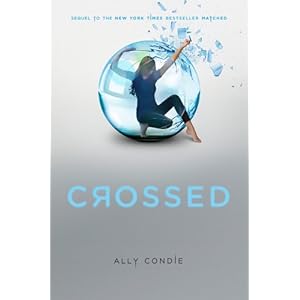
Matched ends with Cassia's multitude of decisions and the repercussions of each. The reader is left with Cassia secretly on the prowl for the elements of her new life - mainly, Ky, which is how Crossed (Condie's sequel) opens. While Matched was only in Cassia's voice, the second novel is written from the perspective of both Cassia and Ky, who are seeking in each other in a new and foreign land. Listen to Condie talk about the two books here.

The Compulsive Reader promises that Crossed is a "much more philosophical and thoughtful book" than its predecessor. I hope that means the women in Condie's second novel drop the damsel in distress theme, which they have begun to do so towards the end of the first. The cover art already speaks volumes about change - while Matched displays Cassia trapped in a bubble, Crossed depicts the protagonist bursting through that bubble, demanding freedom.

I recognize that not every author can tackle every social issue - so maybe this wasn't the trilogy to engage in a political conversation regarding sexuality, although I feel Condie could have easily hinted towards such in small ways. That aside, it looks like Crossed contains a much more independent, questioning, and strong central character than Matched did.

Crossed hit stores today. Buy a copy at Amazon or Barnes & Noble.

Monday, October 31, 2011

A Final Word for Steve Jobs


Novelist Mona Simpson wrote a beautiful eulogy for her brother's death. She read the piece at Jobs' funeral, and it was recently released to the media. Simpson said:

"He was never embarrassed about working hard, even if the results were failures. If someone as smart as Steve wasn't ashamed to admit trying, maybe I didn't have to be."

Read Simpson's full eulogy here.

As an author, Simpson is known for her award-winning novels such as Anywhere But Here.

Sunday, October 30, 2011

Your NaNoWriMo Prep Kit


Tuesday marks November 1st, which means the beginning of the 12th annual National Novel Writing Month (NaNoWriMo). The project began in July 1999 and challenges writers to create a 50,000 word script in 30 days. Last year, over 200,000 participants took up the challenge. You have all of November to write, but you need to prep in the meantime. Here are some resources to help:

1) Read Chris Baty's No Plot? No Problem!: A Low-Stress, High-Velocity Guide to Writing a Novel in 30 Days. Go ahead and take Baty's helpful tips - he founded the project in the Bay Area in '99.

2) Browse Rochelle Melander's Write-A-Thom: Write Your Book in 26 Days (And Live to Tell ABout It). She's no Chris Baty, but she knows what she's talking about.

3) Listen to Baty talk about his original idea for NaNoWriMo at NPR. He speaks with John Ydstie about his project when it was entering its fourth year.

4) Look up your local community of writers and fellow NaNoWriMo-ers for motivation. Chicagoans, check out your hub here.

5) Read about NaNoWriMo success stories! Like this one.

6) Remember to take care of your brain and creative process! This means napping.

Writers - good luck!