Wednesday, November 30, 2011

A Tale of Two Professional Hats


For many authors, the goal is just to get published. Others aim higher - writers shoot for novels on the New York Times Best Seller List, contracts with big time print houses, and a name that's familiar in their literary genre. Award-winning author, Lauren Oliver, has achieved all that before the age of 29. And to top it off? She recently co-founded a book development company that has gained massive media attention.

As an author, she goes by Lauren Oliver. As an editor, she goes by her real name, Lauren Schechter. The reason for the double name, she told Bloomberg Businessweek, is because "she wants to keep the roles of author and editor/entrepreneur separate."

As an author, Oliver's first two books, Before I Fall (2010) and Delirium (2011), have both been on the NY Times Best Seller List, and Fox 2000 has picked up both novels to be made into film. On the editor side of things, Schechter's new company Paper Lantern Lit is growing. PPL is about "building new voices," she says. The editor describes the company as a "literary incubator" for developing fresh author voices.

Paper Lantern Lit is interested in three principles: "versatility, integrity, and passion." Co-founders Schechter and Lexa Hillyer have made their organization stand out in many ways, the most distinguishing that PPL is a literary developing company, not a publishing house. In short, Oliver and Hilley explain on the PPL website that they "are interested in making books...not in manufacturing books - the paper, the glue, the covers, the pages. [They] leave that to the publishing giants. Instead, [they] develop stories. Paper Lantern Lit collaborates with great up-and-coming writers to help bring those stories to life."

So far, both of Oliver's/Schechter's career paths are blooming individually, but also cross each other. Oliver's latest book, Liesl and Po, just hit the middle grade lit world in September and Pandemonium (the second book in her Delirium trilogy) is due out in February; Schechter's company has sold more than 20 young adult books since its origin in 2010. When it comes down to it, though, the author/editor just cares about good stories, good books, and good authors. "A writer, at base," she said in a recent interview, "must understand people."

Check out the Paper Lantern Lit website here.
Pre-Order a copy of Pandemonium here.

Sunday, November 27, 2011

Cyber Monday! Shop at Independent Bookstores for Gender Bending Material


As holiday gift shopping shifts into full swing, a wide variety of new ideas appear on everyone's wish lists. Fancy electronics. Gift cards. Gender neutral picture books.

Children's books that don't follow the hetero-normative, gender-stereotyped households can't often be found in big chain stores like Barnes & Noble. But independent shops like The Book Beat in Oak Park, IL will frequently provide a wider range of viewpoints and content. For example, Mary Hoffman's 2011 The Great Big Book of Families. The picture book features illustrations of the different ways families might be put together: working mom, working dad, two fathers, adoptive parents, different incomes, different foods, different religions, different ethnicities. In fact, the book starts by showing an example of what households often don't look like: a blonde smiling family with a picket fence.

For 29 years, The Book Beat has sold books that other companies won't, particularly children and teen books with an LGBT theme. The shop says in their store statement that they "hope to continue offering our community a creative bookstore that is a brighter artistic alternative to the cookie-cutter retailers."

At The Book Beat, you can find other refreshing titles like Cheryl Kilodavis' My Princess Boy, Alex Sanchez's Boyfriends with Girlfriends, and Leslea Newman's Donovan's Big Day (about a boy who gets ready to serve as ringbearer at his two moms' upcoming wedding).

Venture farther into Chicago to Unabrigdged Bookstore, which has the following categories on their website: Sale Books, Coffee Table Books, Gay Books, Children's Books. On their home page, they state that "it's safe to say that Unabridged is the only bookstore in the Chicago area where a shopper can buy the latest issue of a gay magazine, a copy of children's classic Goodnight Moon or newest title, and pick up the latest literary fiction & non-fiction sensation, all in one stop."

Julia Music, a queer Chicago mom, recently spoke with Pride Source about shopping for LGBT children's books. Regarding her son's favorite picture book, Liz Garton Scanlon's All the World, Music said that "it's important for children to see their world reflected in the literature they read."

Small Business Saturday seemed to be successful all over the country. Do yourself a favor and extend that tradition into Cyber Monday tomorrow - check out some local establishments' websites.

Saturday, November 26, 2011

The Dragon Lady Has Left the Building


Beloved young adult author, Anne McCaffrey, passed away on Monday. Many fans, readers, and writers were sad to see "The Dragon Lady" go. She was 85, and one of the most influential female voices in science fiction.

McCaffrey had an amazing following throughout her career. Her first trio of books were intended to be just that, a science fiction trilogy: Dragonflight (1968), Dragonquest (1970), and The White Dragon (1978). But McCaffrey quickly gained attention and a heavy fan base. Her Harper Hall Trilogy appeared almost immediately: Dragonsong (1976), Dragonsinger (1977), and Dragondrums (1979). The public named McCaffrey "The Dragon Lady" around that time.

Besides the overwhelming success of her Dragonriders of Pern series, McCaffrey also wrote many successful works of fiction, including her 1967 novel, Restoree, which the New York Times called "a satirical work of science fiction for adults [which] lampooned the genre's portrayal of women as helpless chattel." Of the novel, the author said that "she wanted to write a female character who wouldn't be the victim and need a hero to save her, but who would be a hero herself and fight for her own survival." In all her books, the author pushes for female heroines and agency for women.

After all, McCaffrey was the first woman to win the top two prizes for science fiction writing: a Hugo, which she won for her 1968 Weyr Search and a Nebula for her 1969 Dragonriders. Both novellas later became a part of the Pern series.

The author once wrote in her 1977 Dragonsinger (to the female protagonist), "There's something wrong in not appreciating one's own special abilities, my girl. Find your own limitations, yes, but don't limit yourself with false modesty."

Readers and writers will miss McCaffrey, a strong female voice and a unique author. The author passed away at her home in Ireland, where she had lived since the 1970s. A home she called "Dragonhold," because she says it had been paid for by dragons.

To read more about the inspirational author, check out Robin Roberts' biography, Anne McCaffrey: A Life With Dragons.

Friday, November 25, 2011

Book Review: Robert Ward's "Shedding Skin"


Robert Ward channeled a bit of future David Sedaris in his 1972 novel, Shedding Skin. In a series of comical but heartbreaking vignettes, Ward tells the story of a young man named Bobby, from adolescence through the first stages of adulthood. From the basement of a Baltimore home to the mountainside cabin of a crazy family named the Stumps to a hippie commune in Haight-Ashbury (in a world that reveals hints of queer identity), the protagonist truly discovers himself in the most ridiculous coming-of-age story I have ever read. As the author says in the book's final chapters, he "just wanted to find a good skin that [he] could wrap up in, be safe in. Now they are trying to sell [him] another new one - the radical skin." Amid drunken peers and 60s counterculture, Bobby forms a unique worldview.

Structure: 5 out of 5 stars

Ward sets up the perfect book. Chapters are short, powerful, humorous, and action-packed. While, at the beginning, the reader spends a lot of time wondering what is fiction and what is fact (i.e. was carrying the Taco sculpture a life event or a drug-induced fantasy?), the reader quickly pushes aside logic and just enjoys the tumultuous story.

Character: 4.5 out of 5 stars

Bobby is the sole narrator, which works out just fine. The reader doesn't become too attached to anyone else. The protagonist is good company, and he meets a crazy crew. Characters are introduced and then left by the side of the road (sometimes figuratively, sometimes literally). However, the reader rarely feels the loss of a new friend or lover because Ward so quickly brings in a new point of interest. Throughout the book, the author will reference a past character and the reader will remember with fond nostalgia about an earlier chapter, but then move forward, the same way the protagonist does. In this way, the story still feels whole.

My only wish was to hear more about Bobby's father in the book's conclusion. The author draws such powerful father-to-son parallels in the beginning, but then only touches on those points at the end. The reader walks away satisfied, but would have enjoyed an ending tie.

Voice: 5 out of 5 stars

The protagonist is a sensational storyteller. He is witty, charming, and mostly a nerd. From grade school onward, Bobby encounters influential people who he has determined are geniuses and therefore hold all of life's secrets. When they disappoint him, he moves on. The narrator is never dishonest and often overanalyzes situations in a way that is both endearing and a comfort.

Shedding Skin is simultaneously laugh out loud entertaining and historically intriguing. The reader watches a boy find his own two feet without any stereotypical YA drama. In fact, the novel is anything but predictable. Overall, a delightful read.

The book was published in 1972 by Harper & Row, and won the National Endowment for the Arts award in the same year.

Tuesday, November 22, 2011

Overcoming All Odds: Lauren Myracle


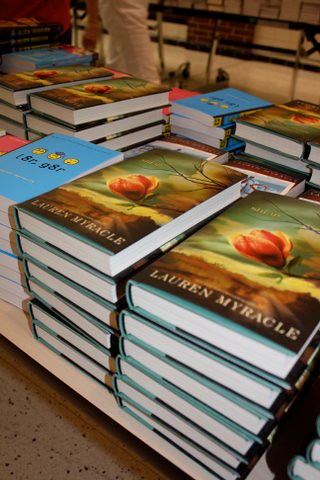
The dust has begun to settle on the National Book Awards scandal. Lauren Myracle was in the running, then pulled, and once Thanhha Lai won in the Young People's Literature category on Wednesday, few people have mentioned Myracle. But her novel, Shine, basked in the National Book Awards news coverage (a.k.a. free publicity), and as an author, Myracle is selling books more than ever before.

Throughout high school, college, and even post-graduation, Myracle met people who insisted she should forget writing. A professor once told her not to bother joining an advanced English course because she wasn't good enough. But Myracle wouldn't take it. "I decided that teacher could tell me I couldn't take her class," Myracle told a Chicago audience at Anderson's Bookshop on Sunday. "But she couldn't tell me not to become a writer."

After graduate school, the Examiner wrote, the author was rejected 118 times before she found an editor who would pay attention to her work. "I wrote [that first novel] five times in a two-year period," Myracle said. Finally, she got a piece of good news: Abrams Books for Young Readers publisher, Susan Van Metre, offered the Shine author a contract. The novel, Kissing Kate, hit bookstores in 2003.

In the last nine years, Myracle has published over twenty works, including ttyl, the first novel ever to be written entirely in instant messages. In 2009, the American Library Association said that the author's books were the most challenged of the year due to their real and often intense scenes of alcohol abuse, sexual encounters, and homosexuality. Even without the added scandal associated with the National Book Awards, Myracle's latest novel, Shine, continues to ruffle feathers in it's own way. Librarians and parents have already protested the book's story line - a teenage girl who tries to discover the who/where/when/why of her gay best friend's murder.

Forget controversy. Forget discouragement. Myracle's two- cents? "Other people tell you you're foolish to want to do [something], but don't give up." With the number of factors working against her, Myracle writes what she wants no matter who says it won't sell, and still manages to give many YA authors a run for their money.

"I live in my own little world," the author says. "But its ok, they know me here."

Monday, November 21, 2011

Occupational Hazards: Debt, Jobs, and Broomsticks


Something a little different today. Here is a short piece about one of my first jobs in the city:


I really needed a job. I was willing to take pretty much anything.

Chicago winter had hit me hard. I had an old car, a drafty apartment, and an empty bank account. The snow had begun the weekend I moved and hadn’t stopped. From a friend of a friend, I had picked up some temp part-time work for minimum wage, but I needed something else soon or I wasn’t going to make it through my first season in the city.

After my shift one night, a co-worker from a different department approached me to say she had an opening for a bizarre position at her other company. It wasn’t much: child wrangler meets house manager for student performances of "The Wizard of Oz."

The job was simple. Wait next to the theater door for a school bus. Then hop on, make some announcements, and wrestle the kids into a line. Also, the El train will be rolling overhead, making it impossible to shout instructions and causing many of the kids to scream. And it will likely be snowing or raining. Pay is $30 a day, before taxes.

“I’ll take it.”

My first day of work, two buses pulled up late, another got lost, one school brought a student with accessible needs and the elevator stopped working, and a first grader threw up in the lobby. I walked six blocks in the rain to bring the show materials back to the main office and then scrambled back into the storm to bum a train ride home. On the way, someone shouted to “move out of the way because I was so ugly I was stopping traffic.” Needless to say, I couldn’t believe I took this crazy job. I was cold, struggling with debt, and working ridiculous hours helping middle-schoolers learn what “single file line” means. To be honest, I was terrified. What if something happened to one of the kids on my watch? What if I caused a traffic accident with the buses? What if I was simply horrible at this position? For now, though, I didn’t have any other options.

Fast forward to Week #5. Back-to-back shows in the morning. In the span of twenty-five minutes, we needed to get 350 elementary school kids out of the theater, onto the correct buses, clear the street, coordinate the next round of schools, and usher 350 different children to their seats inside. With the help of the office staff, we made it just before the second show was slated to begin. Miracle of miracles. I knelt down to take a breather in the lobby.

The doors inside the theater opened and a preschooler walked out, crying. His chaperone couldn’t calm him down. The two of them circled the space and finally sat on the chairs in the corner. I walked over to say hello.

“He’s scared of the Wicked Witch,” the chaperone explained while the boy stared straight ahead, sniffling and avoiding eye contact.

I sat down next to him and said that I was scared of spiders.

He looked up and blinked. “Big spiders?” he asked, and wiped his runny nose on the sleeve of his jacket.

“All spiders. Big. Little. Slimy. Hairy. I’m scared of all kinds of spiders.”

The three of us sat in silence for a moment.

“Want to know a secret?” I whispered. The boy nodded, not quite sure if he trusted me. “Sometimes, I talk to spiders, too. Just to say hi. They never talk back, but I imagine what they would say anyway. Sometimes I think they might ask about what music I am listening to or what movie I like to watch on the weekends. I talk to lots of spiders. It makes them seem less scary. Does that make me weird?” He nodded.

From the side entrance, the actor playing the Wicked Witch came out and waited for his cue. In the florescent glow of the lobby lights, his green make-up looked pale instead of sickly, and he scratched his nose with the tip of his pointy hat. I grinned and motioned for him to come over.

The actor sat down on the carpet and inspected his broom. The boy’s lip quivered, but he didn’t move from his chair. The Wicked Witch continued to play with the bristles and the boy looked on. Inside the house, the piano tune to “We’re Off To See The Wizard” bled through the double doors. After a moment, the boy reached out to touch the broom, too. Both boys, the actor and the preschooler, rubbed the rough, itchy broom hairs in a rhythmic, almost therapeutic motion.

“Your nose looks like mine.” The boy felt the witch's black cape in the same rhythmic way with his fingertips.

The Wicked Witch stood up. “I’ll wave to you from the stage, OK?” The boy nodded and the actor ducked in to make his entrance. Without another question, the boy stood up and walked back inside, ready for whatever the play had in store.

That week, I got a phone call from the temp agency – they had found me a full-time job at a law firm answering phones. Business attire. Thirty minutes for lunch. Could I start Monday?

I looked outside at the snow and sleet and rambling El train, and respectfully declined the offer. The job at the theater was hardly a paycheck, but I liked the challenge. My duties were always different and sometimes daunting, and that was exactly what I wanted. There was no use being afraid of chaos when I loved the excitement. Soon enough, I’m sure I could fight my way out of debt. In the meantime, I had kids and broomsticks to wrangle.

Sunday, November 20, 2011

Jumping the YA Bandwagon


Since the recent explosion of many hits in the young adult fiction world, several publishers with mainly adult or children's reading material have stepped into the YA genre. Chicago-based publishing house Albert Whitman and Company (most famous for the Boxcar Children series) has been printing children's lit since 1919. This was the first year the company launched a young adult line, "Albert Whitman Teen," which included only two titles: Michael Ford's The Poisoned House and Anna Perera's Guantanamo Boy. Coming Spring 2012 will be Anna Perera's The Glass Collector and Deborah Blumenthal's The Lifeguard. The company says their list of YA titles are "smart, fearless books that explore unchartered territory in the world around teens and in their inner lives as well."

Angry Robot Books, on the other hand, has been printing adult science fiction and fantasy books since 2009. They just announced that, come September 2012, the company will also launch a YA line called "Strange Chemistry," with the hopes to print one YA book a month from there on out.

Many publishing houses are embracing the young adult genre, and it looks like other companies will soon follow!

Friday, November 18, 2011

So It's Like "The Office"...But With Books?


For some teens, the initials BFF stand for "best friends forever." For many others recently, BFF stands for "Backlit Fiction Forward," a new and innovative publishing company for the young adult audience.

"Backlit is a next-generation digital media publishing company that creates eBooks and interactive apps based on original franchises," says the company's Facebook page. It "incubates teen serials as episodic apps and film and television properties." In other words, Backlit makes the equivalent of sitcom eBooks, and release each episode as it is written. Teens then have the opportunity to stay connected more often - they can follow an eBook series the same way they can a television series. "We are reinventing publishing by shortening the path from writer to reader," says Jack Giarraputo, film producer of "Heavyweights," "The Waterboy," and "I Now Pronounce You Chuck And Larry" (among many others), and Backlit's creative adviser and lead investor.

The company's first series were recently released: Borrowing Abby Grace; The Start-Up; and The Dig: Zoe and Zeus.

Backlit recognized the habits of today's young adult audience, and saw the untapped opportunity in turning one more thing into a constant supply-and-demand. "Focused on Millennial readers with episodic attention spans," says Market Watch, "Backlit ebook downloads will be released exclusively digitally every few weeks, yet offer significant narrative depth."

The company has even thought further, past the books themselves as a product. They have become not only a self-marketing tool, but also encouraged a kind of "audience participation" to keep readers hooked. Teens will have the upcoming opportunity to win "character walk-on" roles in ebooks, and the Mentors Program will launch in the next weeks, "whereby the publisher will mentor and crowdsource new YA authors to write new episodes."

Backlit has tapped into the growing trends of ebooks and young adults, and supplied a unique experience for teen readers. Upcoming series include Young Americans, Future Perfect, and The Defiants, to be released early next year.

Thursday, November 17, 2011

A Bittersweet Victory


The 2011 National Book Award Winners were announced last night. Audiences applauded the well-deserved wins:

Fiction: Jesmyn Ward's Salvage the Bones
Non-fiction: Stephan Grenblatt's The Swerve: How the World Became Modern
Poetry: Nikky Finney's Head Off & Split
Young People's Literature: Thanhha Lai's Inside Out & Back Again

Five finalists had been chosen for each category. Each finalist won $1,000 and a medal, and each winner received $10,000.

I still wonder, though. After everything that happened in the young adult category with Lauren Myracle's Shine, did Franny Billingsley even have a chance with Chime? (Get caught up with the backstory here). Had too much dust already been kicked up with the two novels? Did the controversy skew the judges final decisions? While National Book Award higher-ups insist that the mix-up "will never happen again," did Chime getting thrown into an unavoidable debate ruining Billingsley's chances?

Regardless, Lai's award-winning YA novel is worthy of the honor and praise it has received. And hopefully the next time Billingsley and Myracle find themselves on the finalist lists for major awards, they will get a fair judging.

Wednesday, November 16, 2011

Chapter One: "Call me Ishmael."


Books are either memorable or they're not. You either finish reading them or you can't. You either recommend stories or you don't. But the first line certainly makes a difference.

"124 was spiteful" - opening line to Tony Morrison's Beloved.

"All this happened, more or less" - beginning of Kurt Vonnegut's Slaughterhouse-Five.

And how could you refuse: "I was born twice: first, as a baby girl, on a remarkably smogless Detroit day in January of 1960; and then again, as a teenage boy, in an emergency room near Petoskey, Michigan, in August of 1974." (Jeffrey Eugenides' Middlesex)

First lines prepare you for the story that almost never unfolds the way you thought it would. You meet the narrator who may or may not be reliable. You read that first line and decide, "Am I committed to this book?"

InfoPlease has compiled a list of the 100 best first lines, ranging from 18th century English prose to 1980s gritty text.

Leave a comment with your favorite first book lines!